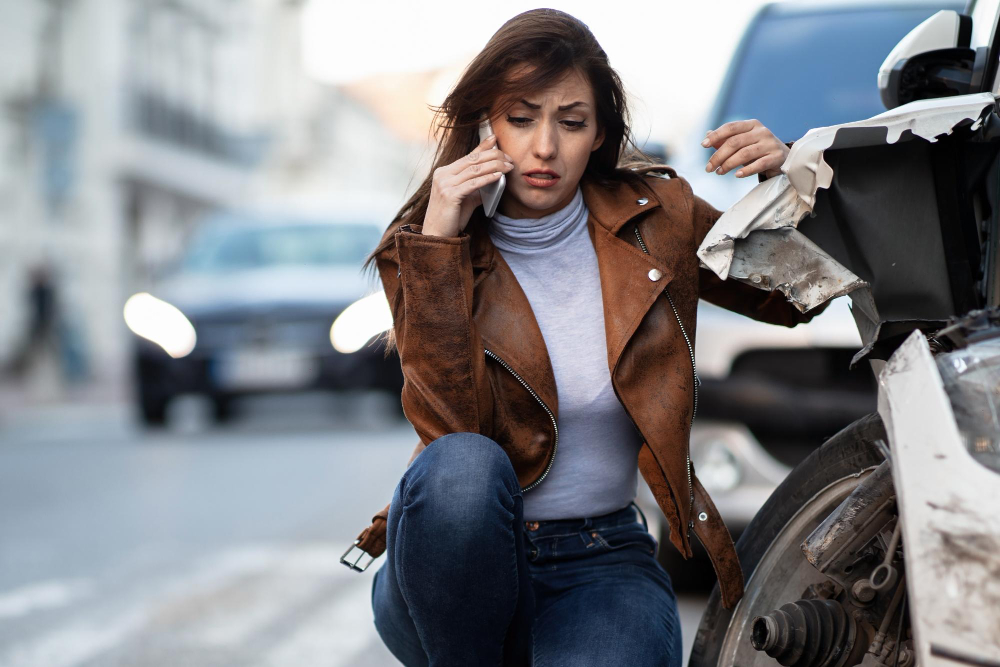
We cannot stress this enough: “As a vulnerable road user, you are always entitled to compensation for at least 50% of your damages”. Being unaware of your rights and obligations can have serious consequences in some cases. For example, we recently assisted a client who, after cycling through a red light, was involved in an accident with a motorist. As a result of the accident, this client was unable to work and consequently found himself in financial difficulty. When we first met the client, we asked him why he had waited several months before contacting us. The answer was that the client feared he would be held liable himself, as he had cycled through a red light and therefore saw it as a lost cause. However, this is incorrect. In this article, we will explain why a vulnerable road user almost always has the right to compensation.
Firstly, Section 185 of the Road Traffic Act is of great importance in this context. Under this section, the driver of a motor vehicle is liable. He can only escape this liability if he can prove force majeure. However, the threshold for this is so high that it is almost impossible to successfully invoke force majeure. It is important to note that vehicle defects (such as brakes that are not working properly) or physical conditions (cardiac arrest whilst driving) do not constitute force majeure. This is because such risks are the responsibility of the driver. This explains the high threshold for force majeure.
With regard to the question of why a vulnerable road user almost always has a right to compensation, the following is important. Motorised vehicles/strong road users can pose a danger to other people and property. As a result, these drivers are subject to what is known as a ‘duty of care’. This means that a strong road user has an additional duty of care to exercise caution in traffic. After all, a collision can have serious consequences. As a result of this extra duty of care, it is only fair that a vulnerable road user/non-motorised party is entitled at all times to at least 50% of their damages. This is because the motorised road user has breached their extra duty of care and is often insured. After all, motorised vehicles also have a duty to be alert to mistakes made by vulnerable road users. The client we discussed above is therefore entitled, in the worst-case scenario, to compensation amounting to 50% of their damages. This is also known as the equity adjustment.
It should be noted, however, that this equity adjustment does not always apply. Broadly speaking, this adjustment does not apply in two cases. Firstly, where there is intent or recklessness bordering on intent on the part of the vulnerable road user. Secondly, if the vulnerable road user already has their own insurance that covers the damage. However, this is almost never the case. Recklessness bordering on intent might include deliberately jumping in front of a car or behaviour bordering on this. A real-life example is cycling towards oncoming traffic at night, without lights, and attempting to swerve at the last moment. It follows that running a red light or an incorrect overtaking manoeuvre is insufficient to establish recklessness bordering on intent.
Based on the above, a vulnerable road user (almost) always retains their right to compensation. This is also the case if the vulnerable road user is at fault themselves, for example by failing to look properly or by ignoring a red traffic light. It is important to note, however, that this is how liability is apportioned in the event of an accident between a strong and a vulnerable road user. The above provides a broad outline of the situation. In practice, there are additional factors to consider. Do you have any questions, or do you know someone who has been involved in an accident as a vulnerable or strong road user? Please contact us so that a professional can assist you. Completely free of charge!